
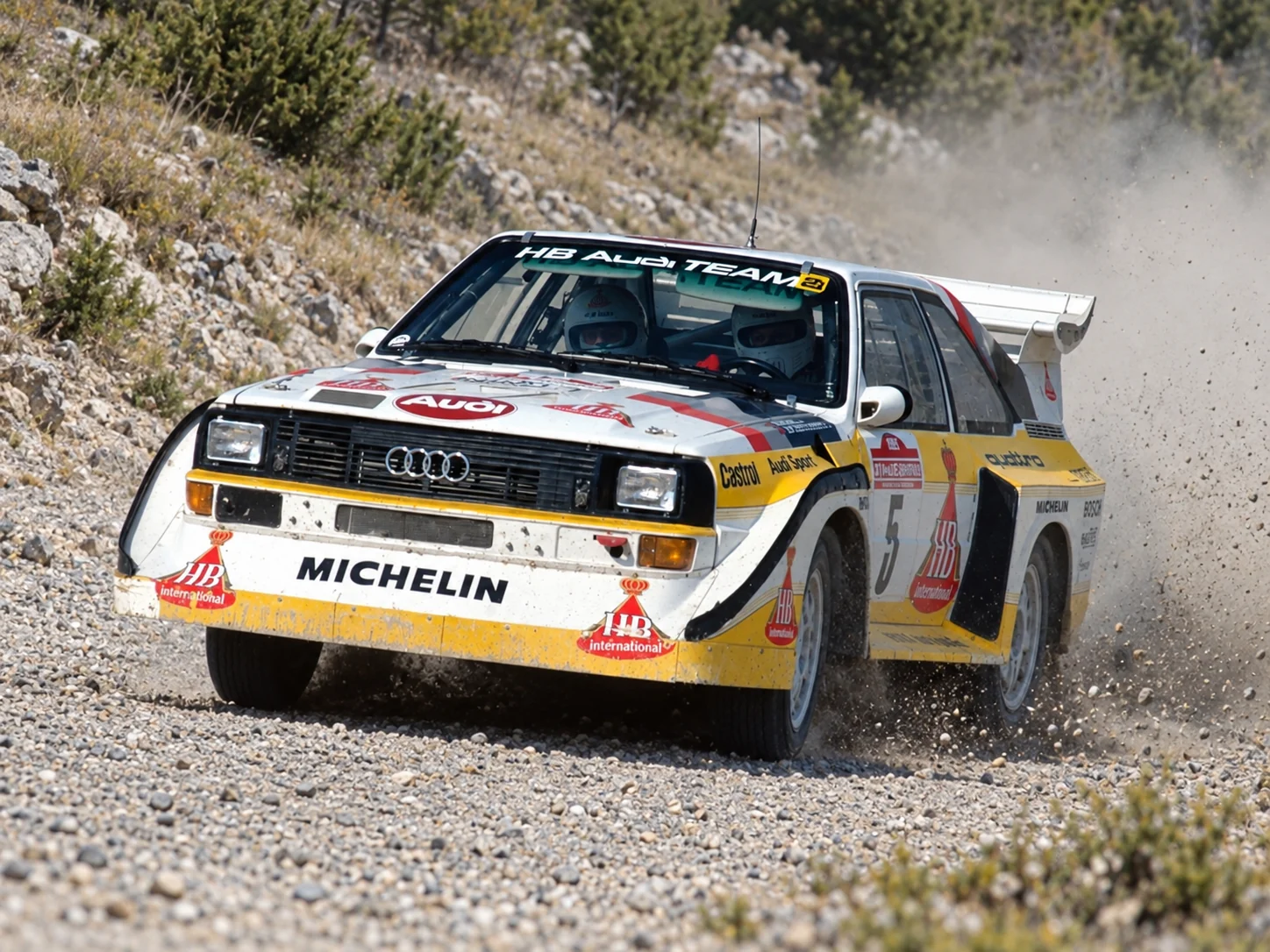
Group B's legacy is often reduced to cars becoming too fast. That phrase captures the drama and misses the harder explanation: engineering, competition rules and the conditions around a rally stage all had to function together. Technical ambition alone could not make the entire system safe.
The machinery remains fascinating. Audi's account traces the shorter Sport quattro to 1984 and the S1 evolution to 1985. Its compact proportions, conspicuous aerodynamic additions and competition-specific layout make the evolution visible. The car pictured here follows a 1985 reference, rather than mixing it with a later Pikes Peak configuration.
Innovation happened within rules
Group B was not literally a class without limits. The FIA's historic database records the Sport quattro S1's homologation, identifying a regulated competition vehicle. Homologation documents and their extensions are more informative than the claim that teams could build absolutely anything.
They also require careful reading. A figure in a homologation record may express a regulatory classification rather than the physical dimension a casual reader assumes. A date showing how long a homologation remained valid does not necessarily describe when the car was eligible for the World Rally Championship.
That distinction matters when tracing development. A competition car can change through approved evolutions and later appear in another discipline. Treating every photograph carrying the same name as one fixed specification erases the engineering story.
The WRC break came after 1986
The championship's own history places the move to Group A in 1987, after Group B was banned from WRC following the 1986 season. That is the relevant boundary for the world championship. It is not a statement that every Group B machine ceased competing everywhere on the same day.
Audi's rally history describes the Group A 200 quattro's 1987 season and the company's continuing Pikes Peak story. Those separate programs explain why later images and results need their own labels. They should not be folded into a claim that the S1 shown here represents every Audi competition specification.
The legend needs the setting
Rallying does not operate inside the controlled geometry of a permanent racing circuit. The route, surface, visibility and people around the stage shape what a driver encounters. Discussing a car's acceleration while ignoring that setting produces a partial account of risk.
It also encourages comparisons that cannot be supported. A claim that Group B cars were universally faster than Formula 1 says little without a defined course, conditions and measurement. Different machines solve different competition problems. The meaningful comparison begins by specifying the test.
Why the engineering still matters
Study a particular car and the story becomes sharper: what changed between versions, what the rules permitted and which problem a new component attempted to solve. The enormous visual impact is still there, but it is attached to identifiable engineering choices.
Group B is worth remembering for both invention and the failure to keep the surrounding system aligned with it. Its most useful legacy is the question every ambitious competition project eventually faces: how does the entire sport keep pace with the machine?
Sources & image references
Researched analysis, updated October 13, 2026. Manufacturer figures and catalog accounts are identified in the article.
Keep exploring