Apple Sets October 28 Event as Mac Expectations Build
Apple has announced a Los Angeles event for October 28. Reports point to new Macs, but the invitation does not confirm hardware specifications.
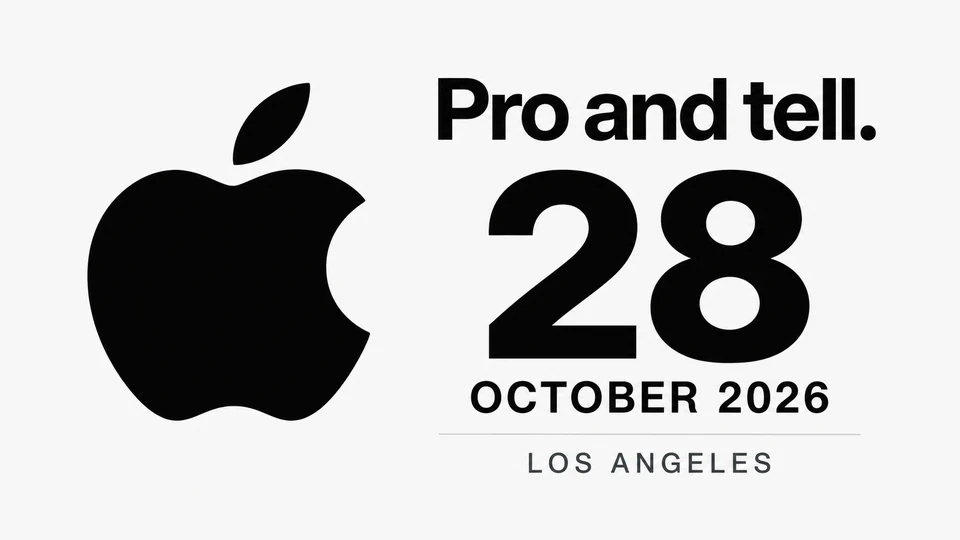
Apple has announced an October 28 event in Los Angeles under the tagline “Pro and tell,” setting a date for its next hardware presentation while leaving the product lineup unconfirmed. Reports point to a major MacBook Pro update, but the invitation itself is not a specification sheet.
The distinction is particularly important for the most closely watched possibility: a touchscreen MacBook Pro. Bloomberg has reported that such a model is expected. Apple’s event announcement does not confirm that feature, a launch price or a delivery date.
The invitation establishes a date, not a product review
MacRumors reports that invited members of the media are due to attend an in-person experience beginning at 10 a.m. Pacific on October 28. Its coverage also points to possible Mac and iPad mini announcements. Those expectations should remain separate from the confirmed scheduling information.
For US readers, 10 a.m. Pacific corresponds to 1 p.m. Eastern on that date. The media invitation should not be treated as a promise of a public livestream. Nor does an invitation to see products establish when customers will be able to order them.
A different screen would need a software explanation
If Apple introduces touch input on a Mac, the useful questions will extend beyond the panel. Buyers would need to understand which applications support the interaction, how the interface handles touch alongside a trackpad and keyboard, and whether familiar workflows benefit. Until hardware and software are demonstrated, those remain questions for the launch rather than findings about an existing product.
For businesses, compatibility and deployment details would matter alongside performance. Local processing and cloud services can have different implications for enterprise data security. An AI feature’s name alone does not explain where a task runs or how company information is handled.
The purchasing decision begins with the final configuration
For a prospective buyer, an event date creates a point at which more information may become available. It does not establish that a current computer needs replacing. The practical comparison begins with the work the existing device cannot complete acceptably, then the specifications, software support and total price of any announced replacement. A rumored feature is not yet a measurable improvement in that workflow.
A touchscreen, if announced, would also change the ergonomics of some tasks without necessarily improving every application. Direct manipulation can be useful in one setting while a keyboard shortcut or trackpad remains faster in another. Evaluating the feature would require demonstrations and application support, rather than inferring broad productivity gains from the presence of a touch-sensitive panel alone.
Configuration details can change the cost comparison considerably. Memory, storage, accessories and support arrangements may affect the amount a business actually pays. Comparing only a starting price with a fully equipped older machine would not be a like-for-like assessment. The launch material would need to identify what is included before those calculations can be made.
Timing has a similar distinction. Announcement, ordering and delivery are separate events, and availability can vary by configuration and market. A company planning a fleet replacement needs delivery dates and deployment testing, not merely a presentation invitation. Until Apple publishes those details, a precise replacement schedule would be speculative.
The event's significance will therefore be established by what Apple actually shows and documents: supported capabilities, pricing, operating requirements and customer availability. Expectations can explain why investors and buyers are watching the presentation, but they should remain labeled as expectations until the company confirms them.
Availability will matter as much as the announcement
TTN’s earlier iPhone Duo preorder report examined the gap between an announced product and the date a buyer can receive it. That experience is context, not evidence that a new Mac or iPad will face the same constraints. Any October 28 announcement will need its own ordering dates, configurations and delivery terms.
The coverage of HomeView and Siri AI follows another part of Apple’s expanding lineup. For the next presentation, the reporting task is narrower: establish what Apple actually introduces, separate shipping features from future promises, and check prices and availability against the company’s published information.
Sources and methodology (4)
Apple’s October 19 invitation is the news event. The earliest verified coverage reviewed here is 9to5Mac at 09:02 Pacific (16:02 UTC); Reuters dated its report 18:08 UTC. The later report does not reset the event’s age. This is a same-day announcement, not a product launch or a development from the latest hour. The date and city were checked against Western coverage of the invitation. Expected products remain reporting and speculation, not Apple-confirmed specifications. The general Apple Events page provides prior-launch context and does not establish the October 28 lineup or a livestream. The cover is an independently generated editorial graphic of the confirmed event name, date and city, not an official Apple invitation.