EUR/USD Responds to Expected Rates, Not Just Today's Gap
Differences between US and euro-area borrowing costs affect currency demand, but growth, hedging and risk appetite can alter the result.
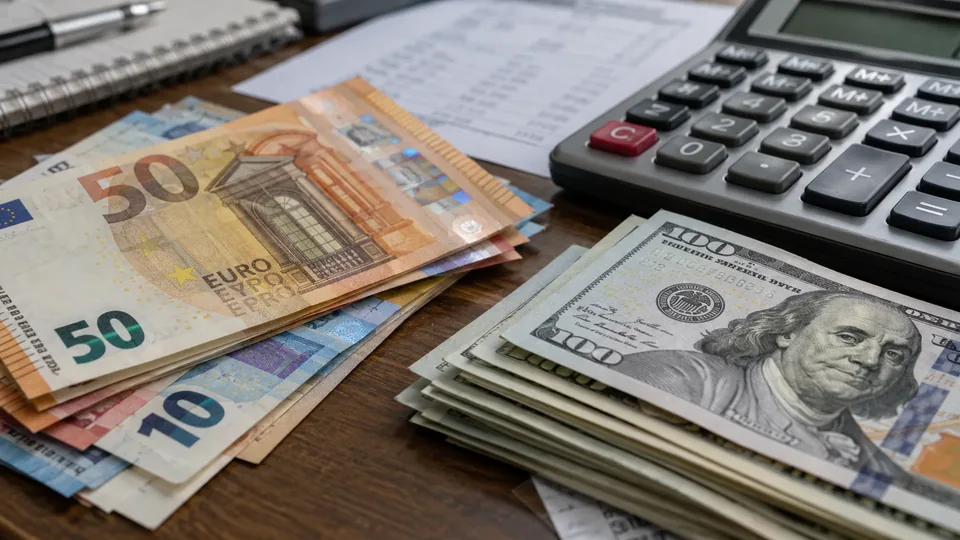
EUR/USD expresses the dollar price of one euro. At a hypothetical rate of 1.10, one euro buys $1.10. A rise to 1.15 means the euro strengthened against the dollar. Getting that quotation direction right is necessary before connecting a currency move with US and euro-area interest rates.
A higher dollar interest rate can make dollar assets more attractive, but the relationship is conditional. Investors care about expected future rates, exchange-rate changes, risk and hedging costs. Today's gap between two policy rates is only part of that calculation.
Match the horizon of the rates being compared
Comparing a US ten-year yield with an overnight euro-area rate mixes different horizons and risks. Even similar maturities can reflect different credit or liquidity conditions. A comparison intended to isolate monetary-policy expectations should identify the instruments, dates and maturities used.
Suppose hypothetical one-year rates are 5% in dollars and 3% in euros. An investor starting with €100,000 at EUR/USD 1.10 can convert to $110,000 and receive $115,500 after one year at 5%, assuming no costs or credit losses. Leaving the money in euros produces €103,000.
If the exchange rate remains 1.10, the dollar proceeds convert to €105,000. The advantage is €2,000 in this simplified example. That result depends on the unchanged exchange rate; it is not a guaranteed reward for choosing the currency with the higher interest rate.
Currency movements can offset the interest advantage
If EUR/USD instead rises to 1.15, the $115,500 converts to about €100,435. The dollar investment produces a small positive euro return, but underperforms the €103,000 available from the euro investment. A favorable interest differential has been more than offset by the euro's appreciation.
The exchange rate at which the two investments match is $115,500 divided by €103,000, or about 1.12136 dollars per euro. This is roughly 1.94% above the initial 1.10 quotation. The precise comparison uses compounded gross returns, which is why simply subtracting the two annual interest rates gives only an approximation.
These figures are hypothetical and ignore transaction costs, taxes and issuer risk. Their purpose is to show the currency exposure in an unhedged investment. An attractive yield in one currency does not establish the return measured in another.
Expectations can change before a central-bank meeting
Currency prices respond to information about the future. If investors already expected a central bank to raise rates by 25 basis points, the eventual increase may add little new information. Guidance suggesting fewer subsequent increases can even make the announcement less supportive for the currency than the headline decision suggests.
Consider a hypothetical market that expects dollar rates to stay at 5% for a year. New information instead points to 5% for six months and 4% for the following six. A simple half-year compounding assumption gives a gross return of 1.025 times 1.02, or 1.0455. That is about 4.55%, despite the current rate still being 5%.
The example is not a forecast and does not reproduce a full market pricing model. It illustrates how an expected path can change while today's policy gap is fixed. The same reasoning underlies the distinction between current rates and futures-implied policy expectations.
Hedging changes the comparison
A currency hedge can lock a future conversion rate, but that forward rate reflects the interest differential and market conditions. Under simplified covered-interest-parity conditions, the one-year forward quotation in the earlier example would be 1.10 times 1.05 divided by 1.03, or about 1.12136. Converting $115,500 at that rate returns €103,000.
The apparent free advantage disappears under those idealized assumptions. Actual hedging costs can differ because of transaction costs, funding constraints and the cross-currency basis examined by BIS. A hedged foreign investment and an unhedged carry trade therefore have different economics.
State the direction of the return
A dollar-based investor holding a euro asset and a euro-based investor holding a dollar asset face opposite currency conversions. The percentage gain in one quotation is not exactly the percentage loss in its reciprocal. Calculations should start with the investor's home currency, apply the investment return and then convert the proceeds using the ending rate.
Rates operate alongside other currency drivers
Growth expectations, trade flows, demand for liquidity and changes in perceived risk can shift currency demand. Investors may buy dollars for funding or safety during stress even when US rate expectations fall. The ECB's analysis of exchange rates emphasizes both expected returns and the role of capital flows and intermediaries.
A precise account states which rate differential changed, whether the change was expected and whether the investor's return is hedged. It then compares the explanation with the timing of the currency move. Interest rates help organize that analysis, but they do not provide a mechanical target for EUR/USD.
Sources and methodology (3)
Primary references for the definitions, methods and risks discussed above. Examples labeled hypothetical or illustrative are not current market quotations.
TTN analysis for informational purposes. This article is not investment, tax or legal advice.