STMicro Raises AI Data-Center Sales Forecast to $1.3 Billion
The chipmaker raised its 2026 data-center revenue expectation. Optical links and power components extend the AI buildout beyond processors.
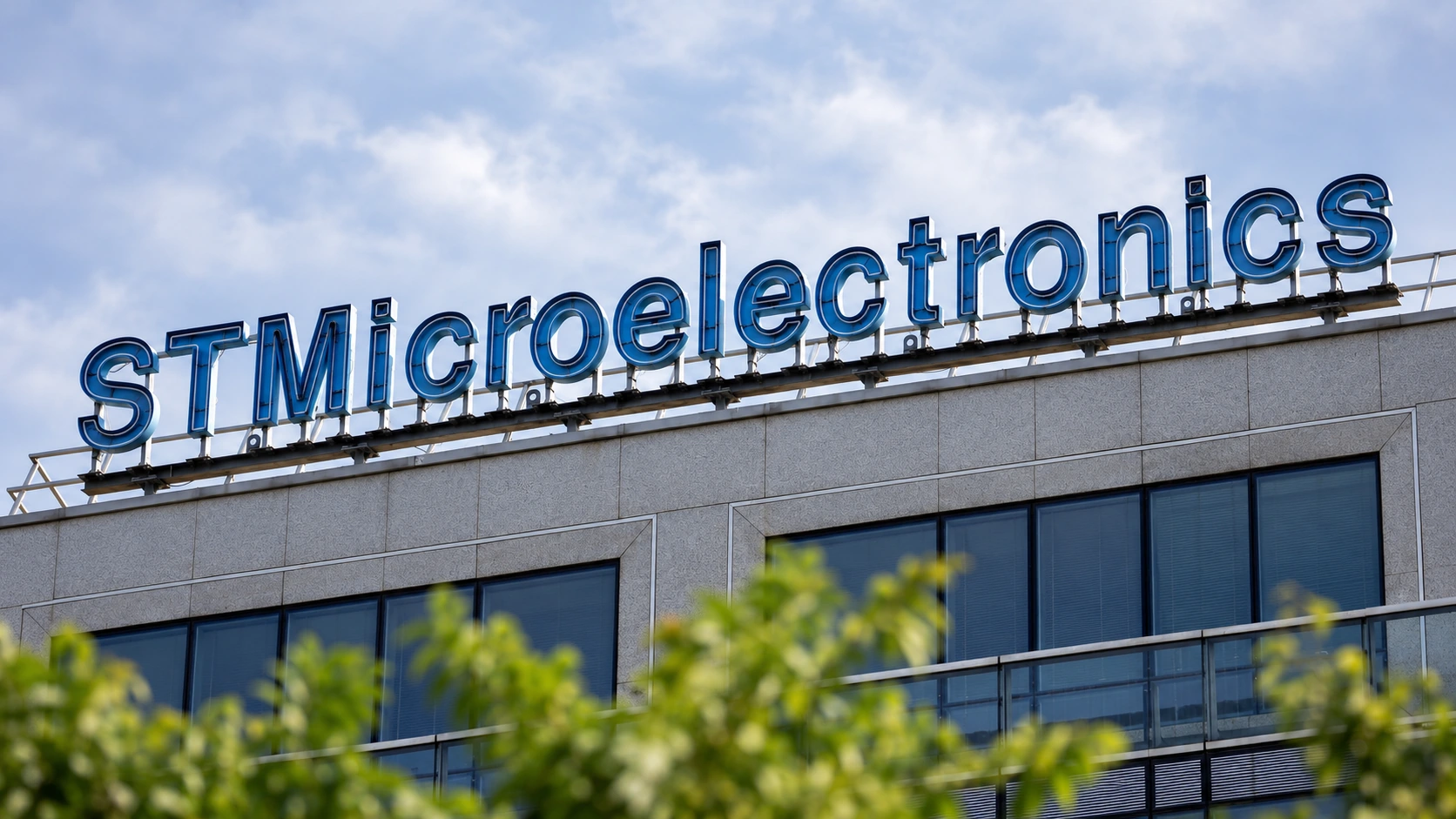
STMicroelectronics raised its expected 2026 data-center revenue to about $1.3 billion on Thursday, highlighting how the artificial-intelligence infrastructure boom is reaching suppliers of optical connections and power-management chips. The Franco-Italian semiconductor company retained its ambition for revenue well above $2 billion from data centers in 2027, subject to continued demand and existing customer engagements.
The new 2026 figure appears in the company's third-quarter investor presentation. Reuters reported that it replaces a July expectation of more than $1 billion and that CEO Jean-Marc Chery identified silicon photonics as the main demand driver. The 2027 ambition was reiterated, rather than newly introduced. These are management's revenue expectations, not completed annual sales or guaranteed customer purchases.
AI servers need connections and electricity as well as processors
ST's infrastructure materials describe a business built around power conversion, high-speed connectivity and optical interconnects. The company explicitly distinguishes its role from designing graphics processors or AI models. Its opportunity sits in the components that help computing equipment receive electricity and move information efficiently within an expanding data-center system.
Silicon photonics uses light to carry information through optical connections. As Reuters reported from Chery's comments to analysts, these chips are an important part of ST's current data-center growth. That is a different market from selling the main accelerator that performs AI calculations. Calling every supplier an AI-chip designer without explaining its role obscures what customers are actually buying.
The distinction also helps connect the company's forecast with the larger investment cycle. More computing capacity creates demand for supporting infrastructure, but a supplier benefits only when its components are selected, manufactured and delivered. Our analysis of AI computing economics explains why bandwidth, utilization and operating costs matter alongside headline processor performance.
A stronger forecast sits inside a wider chip recovery
ST's earlier earnings release reported third-quarter revenue of $3.76 billion, up 17.9% from a year earlier. Gross margin reached 37.3%. Operating income under U.S. accounting rules was $367 million; the company's adjusted operating income was $429 million. Net income was $291 million under U.S. accounting rules and $344 million on its adjusted measure.
Those measures should not be interchanged. Adjusted results remove specified items and can be useful for comparing operating performance, while the reported accounts retain the effects of those items. A reader comparing semiconductor companies needs to check the reconciliation and the period being measured, rather than assume that two figures labeled profit share the same accounting basis.
The presentation puts communications equipment and computer peripherals at 19% of third-quarter revenue, alongside automotive, industrial and personal-electronics customers. That broad category grew 64% year over year. It is larger in scope than the specifically identified data-center revenue forecast, so its sales should not all be relabeled AI revenue. Growth in several end markets contributes to the company's recovery.
For the fourth quarter, ST projected $4.15 billion in revenue at the midpoint of its guidance, with a range of plus or minus 3.5%. It expects a gross margin of about 39%, including roughly 40 basis points of unused-capacity charges. The revenue midpoint would represent growth of about 10.5% from the third quarter and 24.7% from a year earlier. These remain forecasts for a quarter that has not ended.
Demand and capacity have to advance together
Management said demand remained above supply and that the company was expanding capacity in line with its strategic roadmap. Meeting an increased revenue expectation requires production capacity as well as customer interest. Semiconductor orders can arrive well before shipment, and bringing additional manufacturing capability into service creates costs before it produces its full sales contribution.
The latest Microsoft results provide a useful view from the buyer's side: delayed infrastructure deliveries can shift spending between quarters. That does not establish a specific relationship between those delays and ST's forecast. It illustrates why announced demand, installed equipment and revenue recognized by suppliers can follow different schedules.
For investors, the important change Thursday is the higher near-term data-center expectation, supported by a defined place in the infrastructure chain. The next evidence will be shipments, the realized mix of business and the margins generated as capacity expands. A growing forecast broadens ST's AI investment case, while leaving execution and the durability of customer spending as separate tests.
Sources and methodology
Sources checked October 29, 2026. Official decisions, company statements and reported findings are attributed in the text. Financial and operational implications are TTN editorial analysis.
- STMicroelectronics, October 29: investor presentation, including $1.3 billion data-center expectation
- STMicroelectronics, October 29: reported and adjusted quarterly results, outlook and reconciliations
- STMicroelectronics: role of optical links, connectivity and power in cloud AI infrastructure
- Reuters, October 29: revised data-center forecast and management comments