Tether wins 15 industry commitments for software linking Bitcoin mining equipment
Manufacturers and pools plan shared software integrations. The documentation shows how much operational control still rests with mining-site operators.
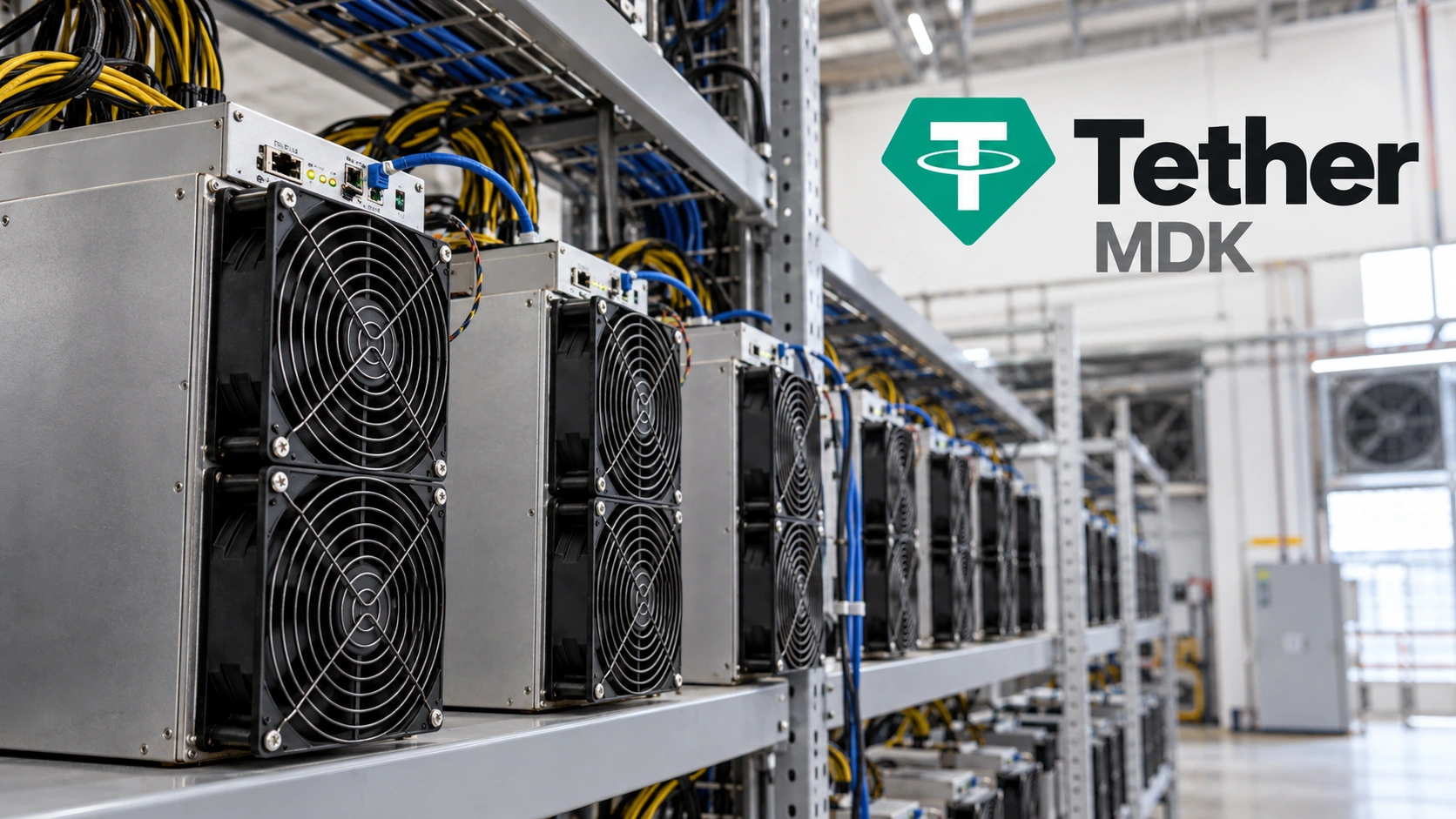
Tether said Saturday that 15 mining companies, equipment manufacturers and related industry participants have committed to building and maintaining integrations for its Mining Development Kit. The open-source software is intended to let applications work across different Bitcoin mining systems. The new commitments address an operational problem: keeping a growing fleet of machines manageable when its components come from different suppliers.
The announcement names Bitmain, Bitdeer, Canaan and MicroBT among manufacturers and operators, alongside pools and other participants including Foundry Digital, F2Pool and Luxor. The list also includes Proto, part of Block, and Stratum V2. Tether describes commitments to integration work, rather than reporting a completed deployment across every participant's equipment or providing a verified share of the global mining fleet using the platform.
Shared interfaces are the immediate product
Under Tether's plan, each participant maintains a software component called a Worker that translates between its own system and MDK's common interface. That would let a developer build against the shared interface instead of writing a different connection for every supplier. Tether targets a first stable version 1.0 by the end of 2026. The framework itself was introduced in April; Saturday's news concerns broader participation, not its first launch.
The current documentation describes a central coordination component, or Kernel, communicating with Workers rather than directly with machines. Applications can then use connecting software to query status or request actions. That separation gives a hardware supplier a place to maintain its integration while an operator builds monitoring and control around the common system. It does not replace the physical equipment doing the mining.
For a mining business, this kind of integration can affect the engineering time needed to add equipment, diagnose faults and maintain monitoring. The financial benefit would depend on whether those changes improve uptime or reduce operating costs after implementation. The economics of Bitcoin mining still depend on computing output, electricity expenditure and competition for rewards. Shared software does not eliminate those underlying constraints.
An AI-ready design is not a completed autonomous mine
Tether presents MDK as a foundation for AI-driven operations, and its product page describes uses spanning miners, cooling, pools and electrical infrastructure. A common interface can make data easier for an application to interpret. Whether an automated system should also change a machine's settings is a separate question from whether it can read the machine's status.
The technical documentation makes that distinction more concrete. It describes intended uses for a shared device-contract file across validation, user interfaces and agent reasoning, but says the user-interface and agent connections to that file are not yet wired up. It also says each site runs its own coordination instance; combining views across sites requires the operator's application code. These limits matter when translating a broad automation claim into a deployment plan.
The business case therefore involves more than installing a package. An operator needs to establish which devices and commands its integration supports, how failures are handled and which actions require approval. Our examination of AI's return in physical operations follows the same distinction between a working demonstration and a reliable process integrated into everyday production.
The operator still owns the access controls
MDK's security documentation says the framework does not supply user-identity enforcement across its layers. Operators must implement appropriate authentication and authorisation around the application and control paths. The documents also distinguish encrypted communication with an endpoint from permission for a person or application to operate equipment. A secure transport connection does not, by itself, answer who is entitled to issue a command.
That is a design responsibility, not evidence of an announced breach. The guidance calls for restricting access to device-management interfaces, isolating components and recording control actions. Connecting more systems through one interface can make operations easier to coordinate while increasing the importance of the controls around that interface. A successful integration needs both useful device access and a clear boundary around who can use it.
This also explains why automation claims should be assessed against the actual work allowed to run unattended. Monitoring can identify a problem without making a physical change. A control action may affect cooling, power use or availability. The relevant permissions and review process depend on the consequence of that action, rather than simply on whether the software includes an AI model.
Saturday's commitments give MDK a wider set of prospective maintainers and integrations. The next evidence of adoption will be working connections, supported-device coverage and operating experience from deployments. Tether has provided a participant list and a development target. Whether that produces a durable shared layer for mining will depend on the integrations being delivered and maintained as equipment and site requirements change.
Sources and methodology
Sources checked October 24, 2026. Reported findings and company or regulatory statements are attributed in the text; discussion of financial implications is editorial analysis. The generated cover is illustrative.
- Tether: October 24 announcement and list of 15 participating organisations
- Tether: original April 27 MDK launch, distinct from the new commitments
- MDK: current architecture, device integration and capability limits
- MDK: security boundaries and operator responsibilities
- MDK: product overview and integration model