The Treasury Cash Balance Changes Bank Reserves Through the Fed's Balance Sheet
Payments and borrowing move cash between government and private accounts. The net liquidity effect depends on who funds the transactions.
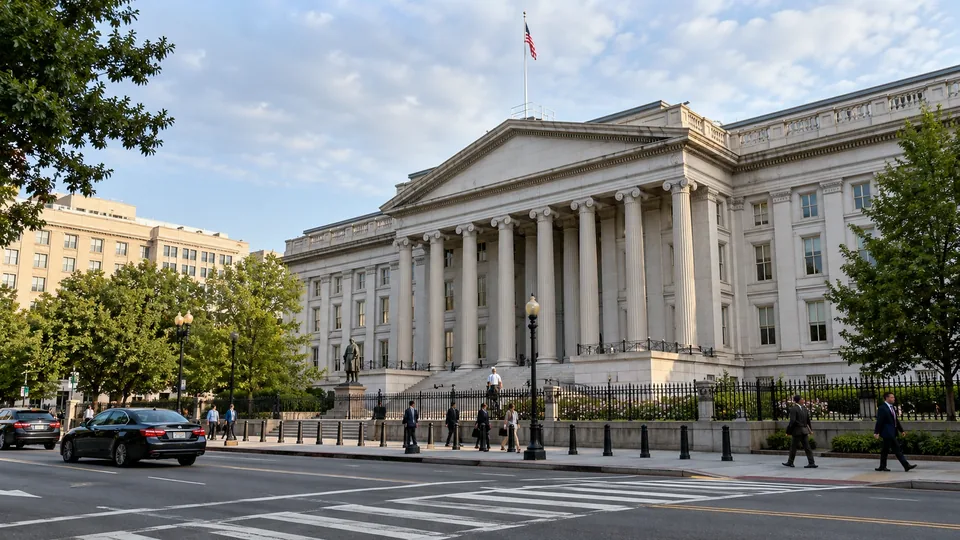
The Treasury General Account, usually shortened to TGA, is the U.S. Treasury's account at the Federal Reserve. It holds cash used for government payments. Changes in that balance can affect banking-system reserves, which is why investors follow it alongside the Fed's balance sheet. The accounting link is real, but it is not a mechanical forecast for stock prices or a complete measure of financial conditions.
The New York Fed describes reserves and the TGA as different liabilities of the Federal Reserve. When other balance-sheet items stay unchanged, an increase in one liability must be matched by a decrease elsewhere. In a simplified setting, money moving into the Treasury's account reduces bank reserves, while government spending moves balances back toward the banking system. Real-world interpretation requires checking the other entries too.
Follow one payment through the accounts
Start with a hypothetical Fed balance sheet containing $1,000 of assets and three liability categories: $600 of bank reserves, $200 in the TGA and $200 of other liabilities. This illustration omits capital and many real categories to isolate the transfer. A taxpayer then pays $100 from a commercial-bank deposit into the Treasury's account, with all unrelated transactions held fixed.
The taxpayer's deposit falls by $100. The bank settles the payment using reserves, leaving aggregate reserves at $500, while the TGA rises to $300. Fed assets are still $1,000, and the three liability categories still sum to $1,000. No asset purchase or sale was necessary for this change. The example is a transfer between liability categories rather than a contraction in the size of the central bank's balance sheet.
Government spending reverses that particular flow
Now suppose Treasury spends $60 from the same account on a payment to a recipient using a commercial bank. In the simplified example, the TGA falls to $240 and bank reserves rise to $560. The recipient's bank deposit increases as the payment is credited. Compared with the original starting point, the combined tax and spending sequence leaves reserves $40 lower and the TGA $40 higher.
The timing matters even when total receipts and spending eventually balance. A large collection followed by payments several days later can produce a temporary shift in reserves. That helps explain why a daily cash-management operation can attract market attention without representing a new decision about the desired level of interest rates. The temporary movement and the policy stance are separate questions.
Do not confuse liability shifts with quantitative tightening
Quantitative tightening concerns a reduction in the Fed's securities holdings under its balance-sheet policy. A TGA increase can reduce reserves even when Fed assets do not change, as the hypothetical tax payment shows. Conversely, other liability movements can offset some effects of declining assets. Reading only the TGA or only the securities portfolio leaves part of the accounting picture out of view.
A second hypothetical week makes the distinction clear. Suppose Fed assets rise by $50 while the TGA rises by $80, with other non-reserve liabilities unchanged. Reserves decline by $30, despite the expansion in assets. If assets instead decline by $50 and the TGA declines by $80, reserves rise by $30 under the same simplifying assumptions. These are accounting examples, not forecasts of a particular week's operations.
Borrowing depends on the funding source
Treasury security issuance can also rebuild the TGA. If a nonbank buyer pays from a bank deposit, settlement can reduce reserves as in the tax example. If a money fund instead shifts $100 out of the Fed's overnight reverse-repurchase facility into new Treasury bills, a simplified end-state can show the TGA $100 higher and that facility $100 lower, with reserves unchanged. This assumes no other flows or asset changes. New York Fed research illustrates why the source of funds matters; issuance alone does not establish a one-for-one reserve drain.
Aggregate reserves do not describe every bank
A banking system can hold substantial reserves in total while individual institutions face different payment needs or funding costs. The New York Fed's discussion of an ample-reserves framework emphasizes that reserve demand is not a single fixed quantity. Distribution, settlement activity and institutions' willingness to lend all affect how comfortable a given aggregate balance feels in money markets.
That is why a claim that a TGA movement releases a fixed amount of buying power into equities goes beyond the evidence. A deposit credit does not tell its recipient to buy shares. A bank reserve credit does not specify a new loan. The connection between payment flows, funding rates, credit decisions and asset prices passes through choices by many institutions, not one predetermined allocation rule.
Match the observation period to the claim
Federal Reserve H.4.1 releases provide balance-sheet information with different observation conventions, including weekly averages and Wednesday levels. A comparison should use consistent columns and dates. A weekly average can move differently from an end-of-period observation when payments are concentrated around particular days. Mixing the two can create an apparent discrepancy that reflects measurement rather than a hidden policy operation.
A useful TGA report therefore states the observation period, shows what happened to reserves and Fed assets, and checks other material liabilities. It then treats any claim about market consequences as an interpretation requiring separate evidence. The account helps explain the plumbing of government cash flows. It becomes misleading when a balance-sheet identity is presented as a reliable trading signal.
Sources and methodology (3)
Primary references support the definitions and reporting methods above. All examples explicitly labeled hypothetical or illustrative are TTN calculations, not current quotations or documented company transactions.
TTN analysis for informational purposes. This article is not investment, tax or legal advice.