AMD Revenue Hits $13.4 Billion as Data-Center Sales Nearly Double
Data-center revenue rose 97% to $8.5 billion. AMD’s $17 billion fourth-quarter forecast puts its next phase of AI expansion to the test.
AMD reported record third-quarter revenue of $13.4 billion on November 3, up 45% from a year earlier, as data-center sales rose 97% to $8.5 billion. It forecast approximately $17 billion in fourth-quarter revenue, plus or minus 3%, as demand shifts toward complete AI computing systems.
A larger business, with a different mix
According to AMD’s release, GAAP net income reached $2.4 billion, or $1.46 per diluted share. Adjusted earnings were $2.09 per share. The company’s combined Client and Gaming segment generated $3.7 billion, down 8%, while Embedded revenue rose 29% to $1.1 billion. These figures make the quarter more specific than a uniform recovery across semiconductors: the fastest expansion came from infrastructure, while the combined consumer-facing segment moved in the opposite direction.
Using the rounded figures in the release, data centers accounted for roughly 63% of total revenue. That is a TTN calculation, rather than a separately reported company metric. It illustrates how much the composition of AMD’s business now influences the overall result. A smaller percentage movement in a large infrastructure segment can outweigh a more dramatic change in a smaller operation, making the source of growth as important as the consolidated growth rate.
GAAP and adjusted earnings exclude different expenses, so the two measures should be compared consistently. Our earnings guide explains how accounting results and expectations affect the market response.
The competitive unit is becoming the rack
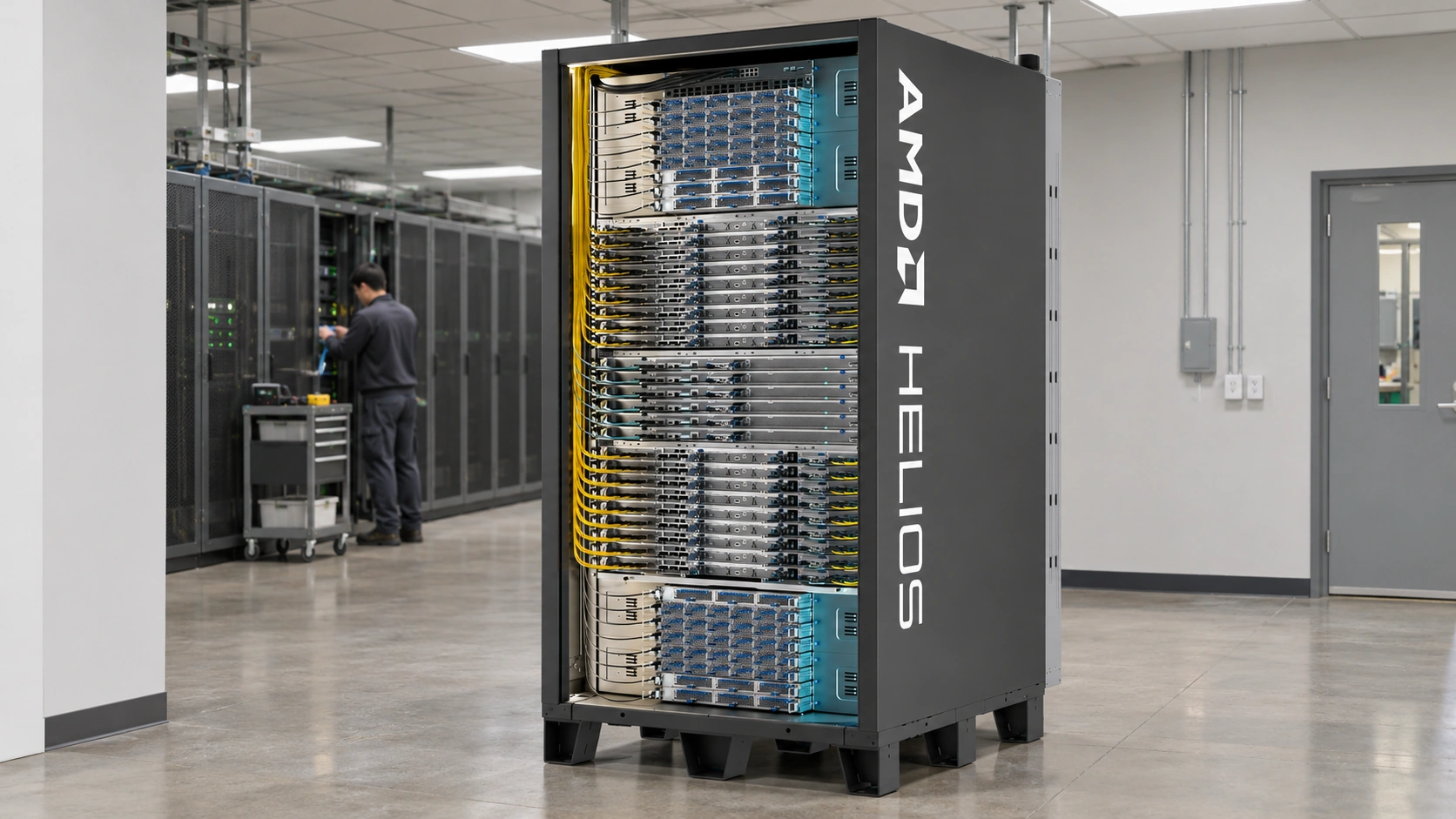
AMD’s Helios documentation describes a system integrating 72 Instinct MI455X GPUs with EPYC processors and networking. It is a reference design for partners, rather than a single finished AMD retail product. Its double-wide rack format, liquid cooling and modular trays illustrate a wider shift in the industry: competing for a customer’s workload increasingly requires coordinating the entire installation, rather than offering a faster accelerator in isolation.
For customers, the relevant comparison is the cost of completing a workload: equipment, electricity, cooling, networking, software and staff time. A cheaper accelerator can be more expensive to operate if integration work or low utilization offsets the saving.
AMD’s product materials also emphasize ROCm, its software environment for running accelerated workloads. Software portability matters because a customer changing hardware suppliers may have to adapt code, retest models and retrain operating teams. These are practical switching costs. Support for familiar tools can reduce friction, but vendor documentation is not an independent measurement of the expense or reliability of a particular customer’s migration.
The physical installation imposes a separate limit. A delivered rack needs an appropriate electrical connection, cooling capacity and network links before it can produce useful output. Those dependencies help explain why a server order, a shipment and a fully productive deployment are different milestones. TTN’s reporting on power delivery and financing in the data-center buildout provides the infrastructure context for that distinction.
The forecast becomes the next checkpoint
AMD’s $17 billion forecast is an expectation, not booked fourth-quarter revenue. Relative to the rounded $13.4 billion reported for the third quarter, it implies approximately 27% sequential growth at the midpoint, a TTN calculation. The scale makes shipment execution consequential: customer acceptance, manufacturing availability and the timing of system integration can influence how much of an anticipated ramp appears within a particular reporting period.
Sources and methodology
Primary sources and supporting reporting.