How Fed Decisions Reach Stocks, Bonds and Crypto
Rate expectations change borrowing costs and valuations. Different assets can react to the same decision for different reasons.
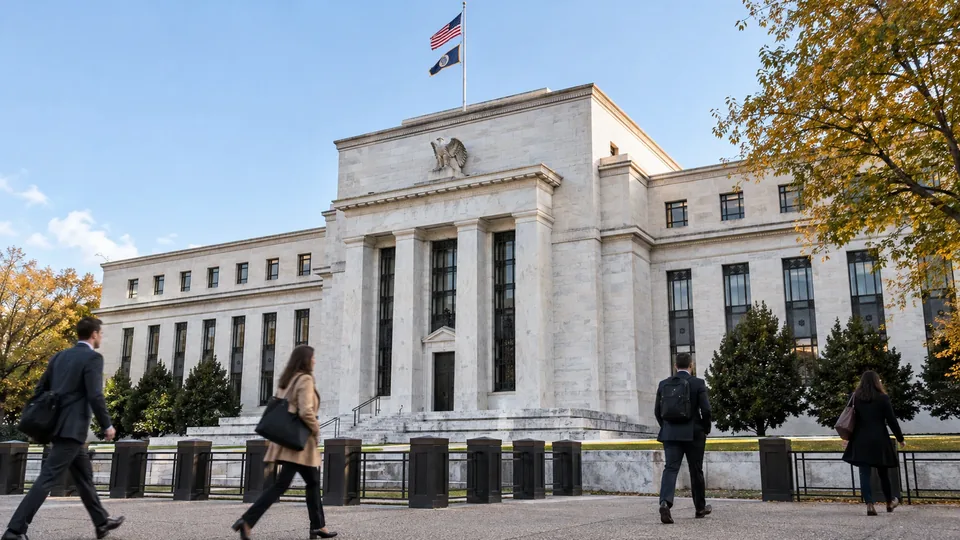
A Federal Reserve decision reaches markets through the borrowing costs and economic conditions investors expect next. The announced interest rate matters, but so do the outlook, the reasons for the decision and the difference between the announcement and what prices already assumed.
That explains why an interest-rate cut can coincide with falling shares or rising long-term yields. Different parts of the announcement may change expectations about inflation, growth and risk in different directions. There is no fixed rule requiring stocks, bonds and crypto to move together.
The overnight rate is the starting point
The Federal Open Market Committee sets a target range for the federal funds rate. The Fed's implementation tools help guide overnight money-market rates. Mortgage rates, corporate borrowing costs and long-term Treasury yields are market prices influenced by expected future policy and other risks; the Fed does not simply set them at its meeting.
The Federal Reserve describes financial conditions as an important route through which policy affects spending and investment. A company facing a higher financing cost may postpone a project. A household refinancing a loan may have less available income. These responses unfold over time and differ according to the borrower's existing contracts and balance sheet.
Separate the decision from the surprise
Suppose investors widely expect a quarter-point reduction. If the Fed delivers that reduction, the decision may contain little new information. A statement implying fewer subsequent cuts could still push some yields upward. The appropriate comparison is between the expected policy path before the announcement and the path inferred afterward.
Futures provide evidence about pricing under particular contract conventions and assumptions, not an opinion poll of every investor. The distinction is explained in the guide to rate probabilities and FedWatch. Statements, forecasts and the press conference can each alter the interpretation of an unchanged headline rate.
Valuation arithmetic holds other assumptions constant
For an illustrative single payment of $110 due in one year, a 10% discount rate gives a present value of $100. At 8%, the present value becomes about $101.85. The lower rate increases today's value, assuming the amount and certainty of the future payment remain unchanged.
Shares represent uncertain streams of future cash flows. If the lower rate reflects a worsening economy, expected earnings might fall enough to outweigh the valuation benefit. The discount rate for equities also includes compensation for risk, which can rise during stress. A policy cut and a higher valuation are therefore not interchangeable claims.
Bond prices respond to the yield that actually changes
Consider a hypothetical fixed-rate bond with a modified duration of five years. A half-percentage-point decline in its relevant yield implies an approximate 2.5% price rise: five multiplied by 0.005. This first-order estimate excludes convexity, accrued interest and changes in credit quality. It does not promise that the bond's yield will fall by the amount of a Fed cut.
A corporate bond also carries a credit spread. If Treasury yields fall 0.50 percentage point while its spread rises 0.75 point, the bond's overall yield rises roughly 0.25 point. Its price could decline despite policy easing. Our duration explainer describes the sensitivity and its limits.
The cash-flow effect depends on refinancing
For a hypothetical $200,000 interest-only floating-rate balance, a fully passed-through quarter-point increase adds $500 of annual interest, or about $41.67 a month. That arithmetic excludes fees and principal payments. A borrower with a fixed rate would generally experience no immediate contractual change until refinancing or the relevant reset.
This uneven timing helps explain why market prices can react within seconds while measured spending adjusts gradually. Cash-rich households can receive more interest income; borrowers may face higher costs. The net economic effect depends on which groups change their spending and how quickly.
Match the event window to the claim
A price observed immediately after the policy statement may precede the press conference or another important disclosure. A later close incorporates a wider set of information. A report attributing the move needs to state its observation window and identify the instrument being measured. Otherwise two valid snapshots can appear contradictory simply because they describe different moments in the announcement process.
Crypto adds financing and market-specific risks
Bitcoin has no contractual payment to discount using the bond example. Policy can affect demand through financing costs, the dollar, portfolio allocation and investors' appetite for risk. Leverage, exchange conditions, token-specific news and forced liquidations can amplify or offset those channels.
A convincing account of a market reaction identifies the changed expectation and the affected transmission channel. The announcement time provides a starting point for comparison. It does not establish that every price move that follows was caused by the Fed.
Sources and methodology (2)
Primary references for the definitions, methods and risks discussed above. Examples labeled hypothetical or illustrative are not current market quotations.
TTN analysis for informational purposes. This article is not investment, tax or legal advice.