Nvidia Targets AI Data Center Power and Water Constraints With European Partners
New DSX announcements focus on dry cooling and flexible power use, but test results do not establish savings across an entire data center fleet.
Nvidia announced an expanded European push for its DSX data center platform Wednesday, bringing power, cooling and infrastructure partners into an effort to make artificial-intelligence computing less constrained by electricity connections and water consumption. The announcements at GTC Berlin put operating efficiency alongside chip supply as a practical limit on AI expansion.
The company says its designs can bring facility cooling-water use close to zero and generate the same AI output with up to 30% less power. Those are conditional company claims, not independently established savings for every installation. Local weather, equipment, workloads and the baseline used for comparison remain central to interpreting the numbers.
Moving heat without evaporating water
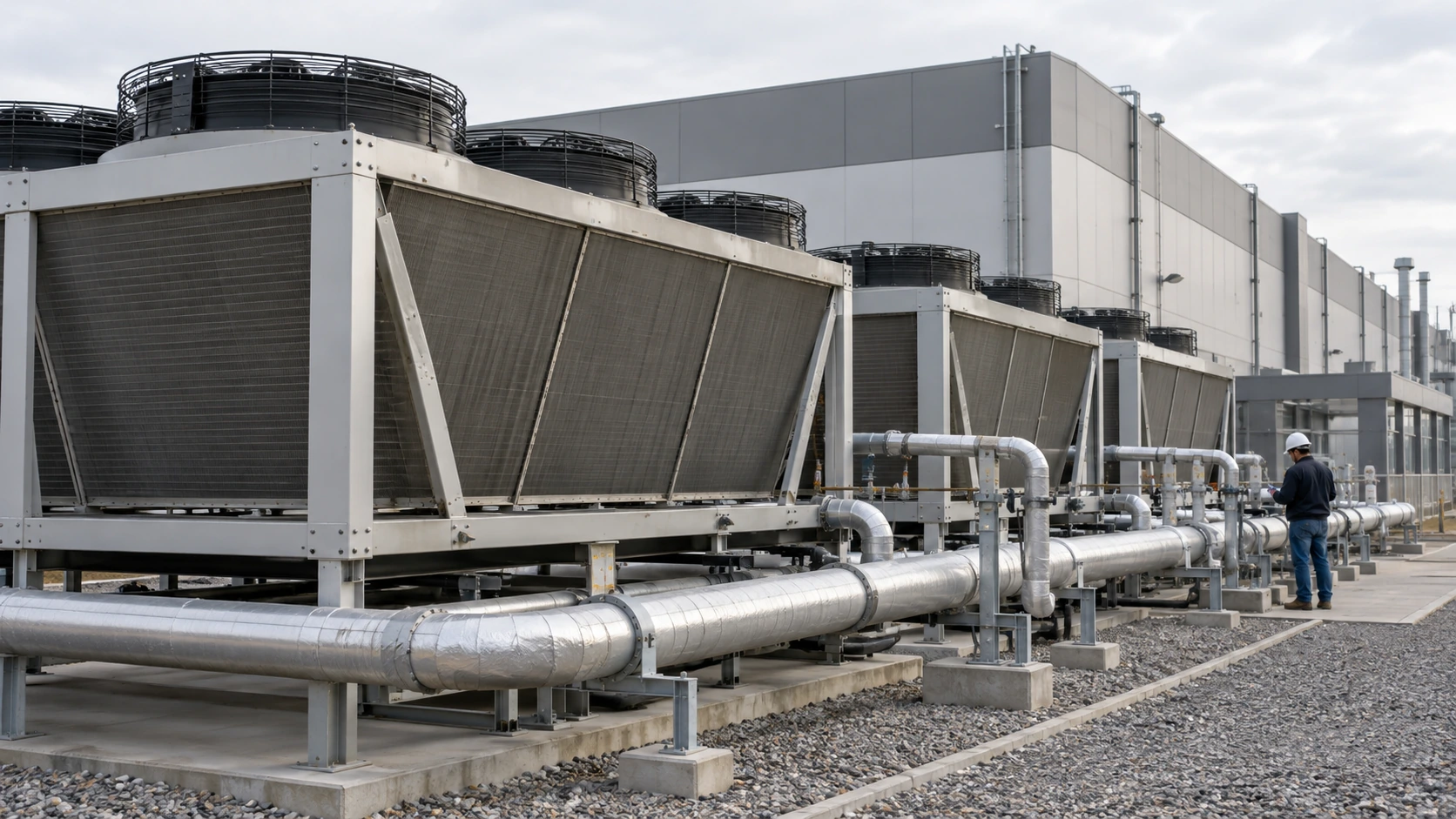
Conventional cooling towers reject heat by evaporating water, which must then be replaced. Nvidia’s proposed approach connects liquid-cooled computing equipment to a closed coolant circuit and outdoor dry coolers. The latter transfer heat to the air through radiator-like surfaces rather than consuming water through evaporation.
The distinction is narrower than saying an AI business uses no water. The claim concerns facility cooling, rather than every water requirement associated with electricity generation, chip manufacturing or the wider supply chain. Nvidia also says local climate determines whether extra mechanical cooling is needed during the hottest periods. A design suitable for one location cannot simply be assigned the same operating economics somewhere else.
For an operator deciding where to build, that changes the comparison between sites. Water availability, summer temperatures and the cost of moving heat become investment inputs alongside land and power. Avoiding evaporative cooling may address one local constraint while leaving electricity delivery and equipment procurement unresolved.
More computing within a fixed power budget
Nvidia describes DSX as a coordinated architecture covering computing, networking, storage, software, power and cooling. Its MaxLPS software allocates power dynamically across equipment and workloads. The commercial idea is to use an existing electrical allowance more productively, rather than assume that every increase in computing capacity requires an equivalent increase in the site’s power connection.
A previously published Lambda case study illustrates the difference between efficiency and outright electricity reduction. In a five-rack test, the cloud provider ran 19 computing nodes within the power budget of a 16-node baseline. Nvidia reports 24% higher token throughput and 23% better performance per watt. Those results describe a specified configuration and workload, not a measured 24% fall in Lambda’s electricity bill.
Tokens are the units of text or other information processed by a language model. More tokens per second can mean more output from an installation, but the financial benefit depends on whether customers buy that extra capacity. Our analysis of AI inference economics explains why utilization and the cost of serving each request matter alongside maximum technical throughput.
Power flexibility has a different purpose
Another component, DSX Flex, coordinates computing demand with grid conditions and available energy resources. Nvidia reports that an early trial involving Emerald AI, EPRI, Nebius and the U.K.’s National Grid reduced a cluster’s power draw by up to 40% during simulated grid events while critical workloads continued. That is a response during a test event, not a claim of permanently cutting all consumption by 40%.
The distinction matters for utilities and investors. A customer able to temporarily change its power draw presents a different operating proposition from one requiring the same supply at every moment. Whether that flexibility actually accelerates a connection depends on the utility’s requirements and the site’s agreement. Software capability alone does not create a guaranteed grid allocation.
Nor does better efficiency establish that total AI electricity demand will decline. An operator may use the additional headroom to install more equipment or serve more customers. The relevant financial question is whether the extra useful output justifies hardware, facilities and financing costs, after accounting for the limits of the local power system.
Wednesday’s announcement advances Nvidia’s ambition to influence the whole computing facility rather than only its processors. Investors still need evidence from commercial deployments: actual uptime, workload performance, cooling requirements and revenue earned from available capacity. Reference designs and pilot results help frame those questions, while leaving the eventual return on each project to be demonstrated.
Sources and methodology
Sources checked October 21, 2026. Reported findings and company statements are attributed in the text; discussion of their financial implications is editorial analysis. The generated cover is illustrative.