Google Runs AI in Orbit for the First Time, Testing the Future of Space-Based Data Centers
Google’s Project Suncatcher prototype successfully ran an AI model on a TPU in orbit, advancing an ambitious but unproven vision for space-based computing.
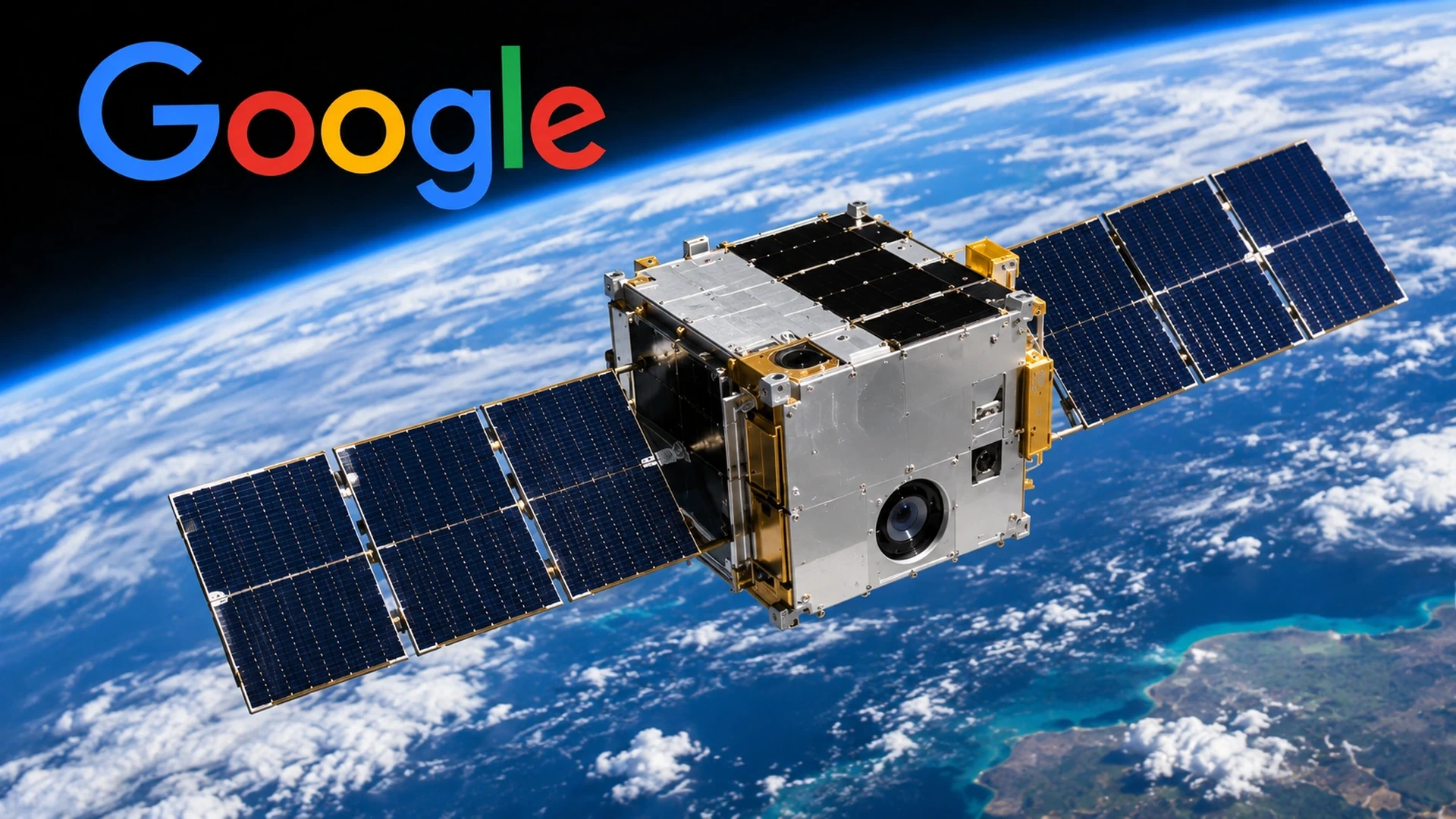
Google has generated an artificial intelligence response using a data-center-class processor aboard a satellite, an experimental milestone in its effort to explore AI infrastructure beyond Earth. The Project Suncatcher spacecraft, built with Planet, launched on October 1 aboard SpaceX’s Transporter-18 mission. Google announced on October 30 that engineers had completed early commissioning, powered up the onboard equipment and run its Gemma 4 model in orbit. The test involved transmitting a prompt during a ground-station pass near Svalbard, Norway, and receiving the model’s response on Earth.
A successful demonstration, not an orbital data center
The accomplishment establishes that a specialized AI processor can perform a generative workload in the space environment. It does not establish that a commercial data center is operational above Earth. According to technology reporting, the spacecraft carries four Tensor Processing Units but can operate only one at a time for a limited period because of power constraints. A short exchange with an AI model is a very different workload from the sustained computation, storage and communications performed by conventional data centers.
The distinction is important for investors and technology companies watching the rapidly growing cost of AI infrastructure. A demonstration proves one engineering possibility; a viable business requires dependable performance and competitive economics over years. Google has not demonstrated that orbital hardware can meet those conditions at commercial scale.
Why compute in space is attractive
Google’s long-term vision involves groups of solar-powered satellites connected through high-speed optical communication links. Spacecraft in favorable low-Earth orbits can experience long periods of sunlight, potentially improving energy availability compared with some ground installations. Electricity demand is becoming a defining constraint for AI expansion, alongside chip supply and the time required to build facilities and grid connections. Our analysis of AI data-center electricity demand examines that bottleneck in the terrestrial market.
Yet the apparent advantage of sunlight is only one component of the calculation. The cost of launch, manufacturing, communications, thermal management and replacing aging processors must be counted. A spacecraft cannot receive a routine hardware upgrade as easily as a server rack in a terrestrial facility. And a satellite performing work on behalf of users on the ground must still receive inputs and transmit results.
Heat and radiation present difficult tests
AI accelerators produce significant heat. Terrestrial data centers rely on air or liquid cooling systems, while spacecraft must ultimately reject heat through radiators. That requirement creates a direct trade-off between computing capacity, mass and the size of thermal equipment. Radiation presents a separate problem: energetic particles can interfere with electronics and shorten their operating lives. The Suncatcher mission is designed to gather evidence about both challenges under genuine orbital conditions.
Google’s next planned step is a test of two interconnected satellites in 2027. Such a mission would examine whether satellites can exchange information fast enough to support distributed AI workloads. Optical communication systems would need precise alignment while spacecraft travel at high speed relative to one another. High bandwidth is essential for tightly coupled accelerators, and today’s ordinary satellite networks are not substitutes for the links found inside major compute clusters.
What this means for the AI industry
The new experiment arrives as technology investors question how quickly multibillion-dollar spending on AI can produce sustainable returns. Google’s approach is exploratory rather than an immediate alternative to terrestrial construction. It may eventually prove suitable for specialized computation close to the data being collected in orbit, but the business case for serving ordinary cloud customers remains speculative.
The first orbital AI response is nevertheless newsworthy: a data-center-class processor has executed a real generative model outside Earth’s atmosphere. The next test is not whether it can generate another answer. It is whether engineers can make the hardware operate reliably, share work across spacecraft and deliver useful results at an acceptable cost. Until that evidence emerges, the term “space data center” describes a possible future infrastructure model rather than an established commercial service. The project will also face questions about orbital debris, licensing, sustainability and the operational life of expensive processors. These constraints make rigorous long-term testing as important as the initial model demonstration.
For a future orbital computing network, a further challenge will be scheduling workloads around each satellite communication windows, eclipse periods and thermal limits. These constraints could determine whether such systems are useful for occasional inference tasks or more demanding continuous services. The current mission does not yet answer that question.
Sources and methodology
Primary company statements and technical documentation; market interpretation is TTN Finance editorial analysis.